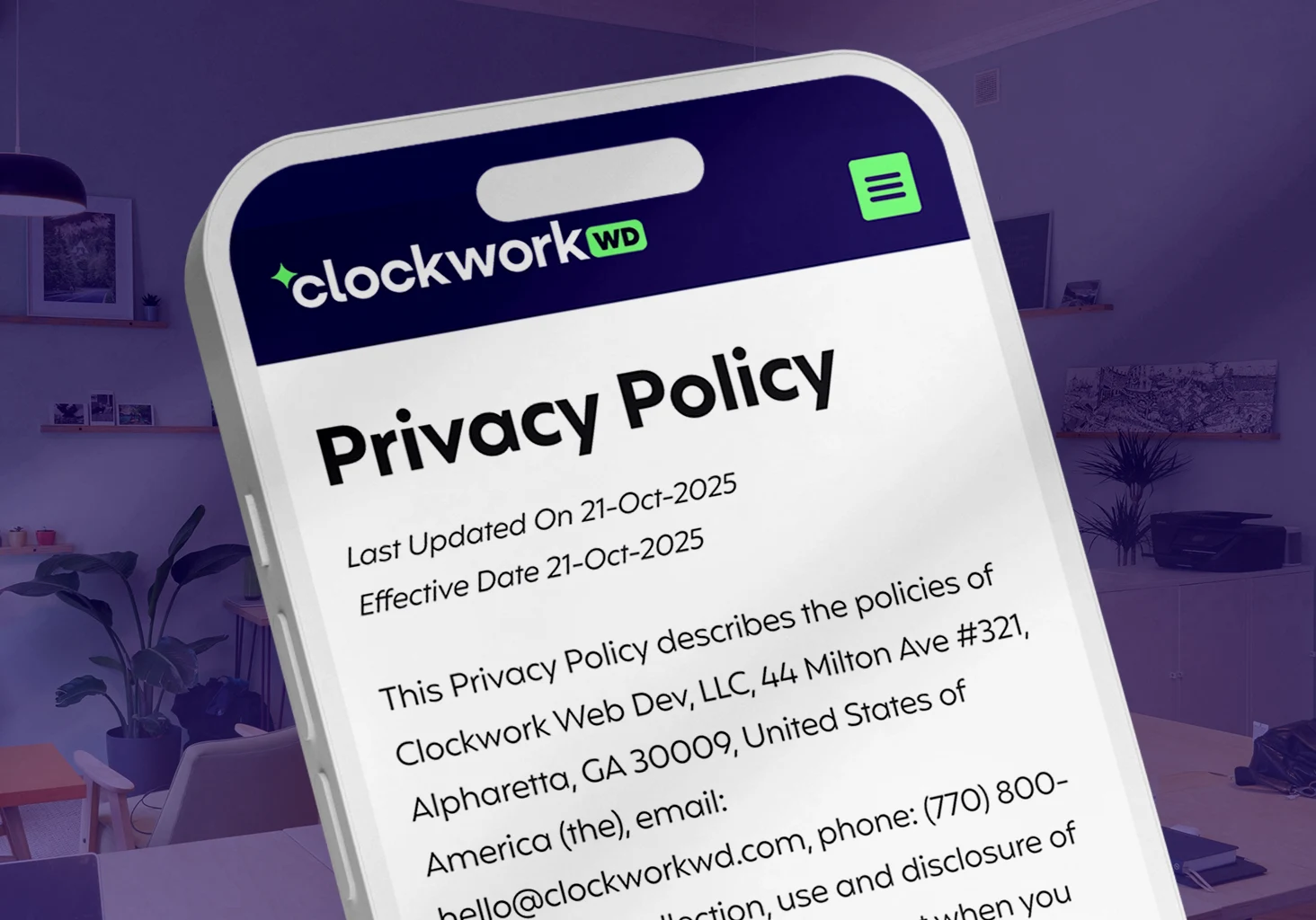
We see plenty of websites that look professional, function smoothly, and deliver great
user experiences here at Clockwork. But then, when I scroll down to the footer… nothing.
No privacy policy link. No Terms of Use. Just a copyright notice sitting there like the
last person at a party.
But does a copyright notice really matter? Yes, because a missing privacy policy isn’t just unprofessional, it’s risky business.
Whether you’re collecting email addresses for a newsletter, tracking users with Google
Analytics, or processing payments, you’re handling personal data that you have a
responsibility to protect. And handling personal data without a privacy policy? That’s like
ignoring responsive design – you’re setting yourself up for problems.
Let’s quickly cover why privacy policies build trust, what legal requirements mean for you,
and how to create one that shields your business from costly mistakes.
TL;DR: Why Privacy Policies Actually Matter
Think of your privacy policy as the trust foundation for your entire website. Just like
how Michael talks about building “Know, Like & Trust” into our web design process for homepages, a privacy policy directly supports that trust element of your site in a few different ways:
- Building Reputation Through Transparency – Users want to know what
happens to their information. A clear privacy policy shows you’re serious about
protecting their data. - Meeting Legal Requirements – Laws like GDPR and CCPA (more later)
have real consequences. Even U.S.-based businesses need to comply if they have EU users. - Professional Credibility – These days, a missing privacy policy
signals an unfinished website, just like typos or ignoring responsive design.
Those legal requirements are more widespread than many realize, and deserve a closer look.
⚠️ A Quick Note on Legal Advice
We can absolutely help you set up these tools and build privacy compliance into your website from the ground up. But for sensitive data like health records or financial information, an attorney provides the legal guidance to keep compliance iron-tight. We are not attorneys and we do not provide legal advice. We always recommend having your corporate counsel review anything on your website that has legal implications.
Understanding the Legal Landscape
Privacy laws have gotten a lot more complicated in recent years, and they affect way more websites than most business owners realize.
What Is GDPR?
- A clear privacy policy disclosing data practices and third-party sharing
- Consent mechanisms like cookie banners so users can actively agree before you track or store their data
- An easy way for users to request, access, or delete their data
- Proper security measures to protect personal data
- A process to notify users if there’s a data breach
But what if my company is located in the U.S - am I expected to follow the GDPR guidelines?
Technically, yes. U.S. companies are expected to follow GDPR if they handle the personal data of people located in the European Union. It doesn’t matter where your business is based. If you sell products or services to EU residents, even online, or track EU visitors on your website (via cookies, analytics, forms, etc.), then GDPR applies to you.
For many small U.S. businesses, the risk of enforcement might feel low, but bigger companies, or anyone planning to grow internationally, should absolutely take GDPR seriously. At the very least, having a compliant privacy policy and a cookie consent banner builds trust with all your visitors, not just those in Europe.
What are some of the U.S.-specific privacy laws?
On the U.S. side, the California Consumer Privacy Act (CCPA) led the charge. It applies to businesses that meet certain thresholds like gross revenues over $25M, handling data of 100,000+ CA residents or households, or earning 50%+ of revenue from selling California residents’ personal information.
Key requirements include:
- User rights to access, delete, or correct their personal data
- Privacy policy explaining what personal info you collect, use, or share (if any)
- Opt-out rights for the sale of personal information (that’s why you see “Do Not Sell My Personal Info” links)
- Data portability rights (users can request a copy of their data)
- Notice if sensitive data is collected
Several other states have followed with their own consumer privacy acts:
- Virginia (VCDPA) – Effective from 2023, requires privacy policy transparency, opt-out for targeted ads and data sales, and rights to access/delete data
- Colorado (CPA) – Effective July 2023, similar rights as Virginia plus stricter requirements around consent for sensitive data
- Connecticut (CTDPA) – Effective July 2023, provides access, correction, deletion, portability, and opt-out rights
- Utah (UCPA) – Effective Dec 2023, slightly lighter version with fewer obligations on businesses, but still requires disclosure and opt-out for data sales/targeted ads
Other states are on the way. Oregon, Texas, Delaware, and a few more have signed laws that roll out in the next few years. Getting ahead of these requirements now saves potential fines or legal issues later.
Checklist: How to Generate a Privacy Policy
If you’re reading this, you’re probably trying to figure out what actually goes in a privacy policy. The good news is that the core elements are fairly straightforward:
- Your company’s contact info so people know who’s behind the site.
- What personal information you collect like emails, names, IP addresses, payment details, cookies, and analytics data.
- Why you collect it for newsletter signups, analytics, purchases, or site improvements.
- How you use that info to send updates, improve your site, personalize experiences, or process orders.
- Third-party sharing including analytics tools like Google Analytics, payment processors like Stripe, or marketing platforms.
- International data transfers if you use services that store data outside the user’s country.
- User rights over their data including how they can access, delete, or opt out.
- How to exercise those rights through contact forms, email, or account settings.
- Data security measures you take to protect personal information from unauthorized access.
When we build websites at Clockwork, we map out these data collection points with clients early on. Building privacy compliance in from the start saves time and resources down the road.
🔄 Reinforcing Your Safeguards
Privacy laws evolve, and we track those changes on the technical side. But an attorney protects you legally as regulations shift in ways policy generators and web teams can’t.
Creating Your Own Privacy Policy
Several tools can help you generate a basic Privacy Policy. Iubenda generates policies with regular updates. Termageddon provides attorney-drafted policies with automatic updates. CookieYes includes privacy policy generation and cookie consent management (remember, GDPR and many state laws require cookie consent banners alongside your privacy policy).
We’ve used these tools at Clockwork, and they’re solid starting points. But they create generic policies based on your inputs and can’t account for your specific business practices or industry requirements. We always suggest verifying everything these generators produce, especially when there’s anything beyond basic contact forms and analytics.
If your business handles extra sensitive data like health information or financial records, we always recommend clients consult with an attorney. The cost of proper legal guidance is typically far less than dealing with non-compliance down the road.
Getting Privacy Right From Day One
A privacy policy isn’t just a box to check off. It’s part of building trust with your visitors, just like how strategic design choices create better user experiences. At Clockwork, we address privacy policies early on in the web design process rather than treating it as an afterthought.
Whether you use a policy generator or work with an attorney, make sure your privacy policy accurately represents how you actually handle data. Keep it updated when you add new features to your website, and make it easy for visitors to find in your footer.
We’ve covered some of the laws that apply, the elements you need, and the tools that can help. But getting privacy compliance right means understanding both the legal requirements and how they connect to your actual website functionality.
Ready to build a site that handles privacy right from the start?
Let’s talk about your needs and how we can help. Reach out to us to schedule a call.