State and local government organizations just got an extra year to meet federal web accessibility standards, and there is a lot to unpack.
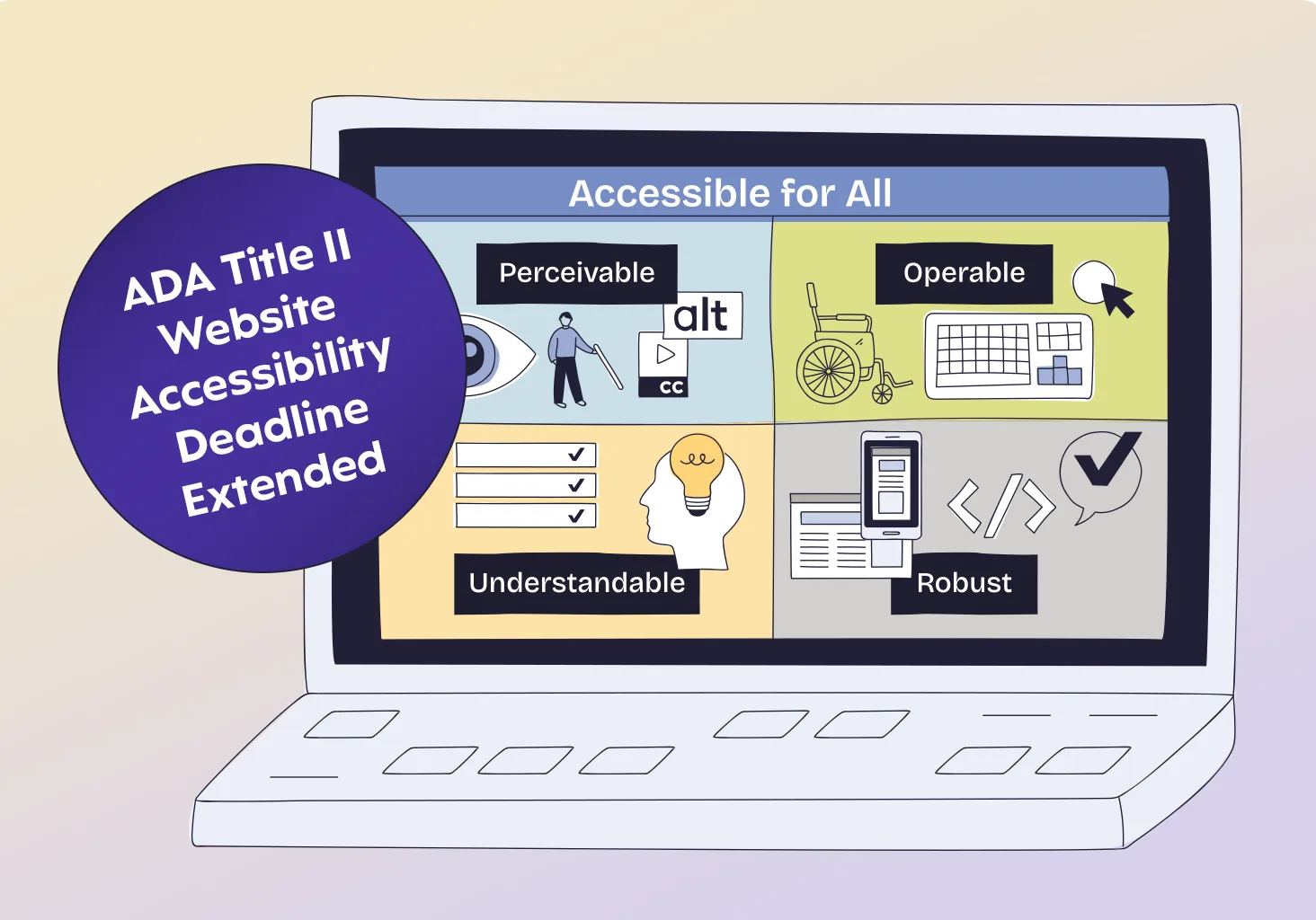
The Department of Justice published an interim final rule on April 20, 2026 extending the compliance deadline under Title II of the Americans with Disabilities Act. The extra time gives most publicly-operated entities until April 26, 2027 to comply with the Web Content Accessibility Guidelines (WCAG 2.1 Level AA). Smaller government entities and special district government groups got a longer extension, until April 26, 2028.
It’s good news if you were scrambling (or unaware there was a deadline at all), but the clock is still ticking. This article covers everything you need to prepare for next year’s deadline.
Disclaimer:
What the Extension Rule Requires
In 2024, the DOJ published a first-ever rule establishing specific digital accessibility requirements for public entities. The compliance deadline was April 24, 2026. The deadline changed, but the requirements are the same.
This rule applies specifically to state and local government entities. That includes public colleges and universities, K-12 school districts, municipalities, and all counties. Private businesses and nonprofits are not included under Title II, though they have their own obligations under Title III of the ADA.
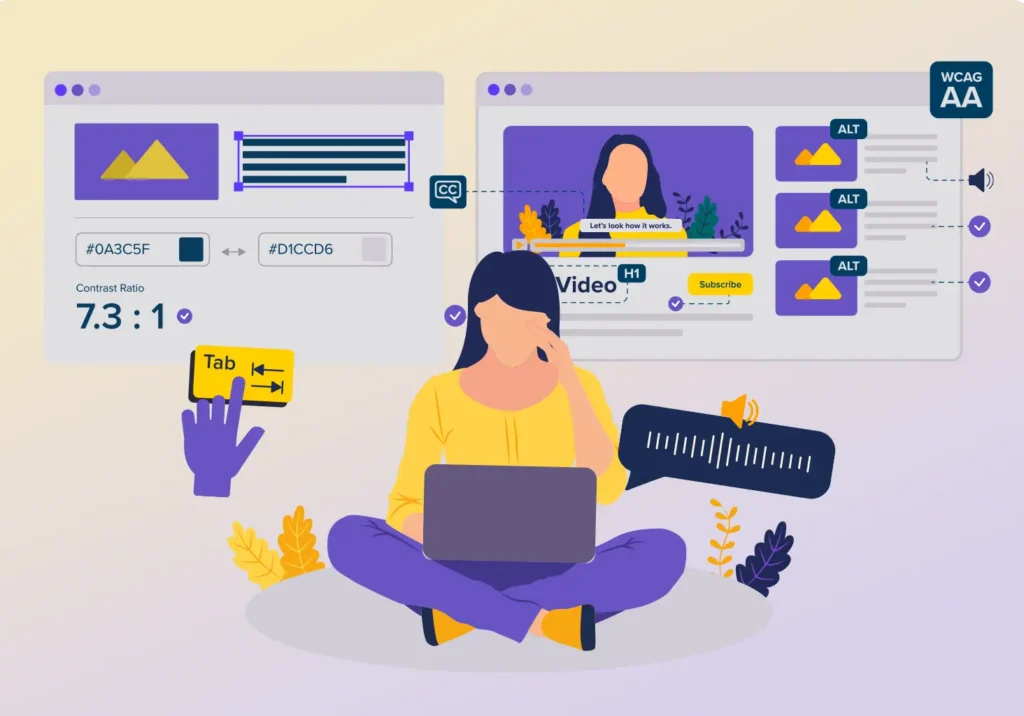
If your organization falls into those categories above, you need to ensure all websites and mobile apps meet WCAG 2.1 Level AA standards by the deadline. That includes:
- PDFs and documents readable by screen readers
- Videos with captions and audio descriptions
- Descriptive alt text on images
- Forms that work without a mouse
- Third-party platforms embedded on your site meeting the same guidelines
This applies regardless of how much content your organization has online. A small county website with 20 pages has the same obligation as a state university portal with thousands.
Why the DOJ Extended the Deadline
The DOJ was direct about why it granted the extension, noting they “overestimated the capabilities (whether staffing or technology) of covered entities to comply with the rule in the time frames provided.” Higher education groups specifically asked for an extension, citing the significant resource and staff commitments required to get into compliance.
The document shows elementary and secondary education groups raised similar concerns. They noted limited budgets and the real risk that rushing compliance would produce box-checking rather than meaningful accessibility improvements that help end users.
There was also a more technical wrinkle. The rule links to WCAG 2.1 resources that have themselves been updated since the rule was finalized, creating confusion about exactly which version of the standards to work toward. The extension gives the DOJ time to address that ambiguity before enforcement kicks in.
The delay is not without controversy. Several disability advocacy organizations pushed back on the extension, and the concern is legitimate. One in four adults in the United States has a disability. An additional year on the compliance clock is an additional year of real barriers for real people trying to access your site. The deadline moved. The case for getting this right did not.
Ongoing Legal Challenges to the Extension
The extension has since drawn legal challenge. In May 2026, the National Federation of the Blind (NFB) filed a federal lawsuit against the DOJ and HHS, arguing the agencies violated the Administrative Procedure Act by issuing the delays without required public notice or comment.
As the press release explains, the NFB is asking the court to block the extensions and restore the original compliance deadlines. The case is ongoing and no ruling has been issued. We’ll keep an eye on the proceedings and update this article with any significant changes. For organizations planning their compliance work, that open question is a reason to keep moving, not to pause.
What This Means for Your Organization
The extension moves the deadline, not the obligation. Public entities have been required to make their services accessible under the ADA for decades. What the 2024 rule added was a specific technical standard and a hard date for web and mobile compliance. That date is currently April 26, 2027, though as noted above, that may come more quickly depending on how the NFB lawsuit resolves.
And beyond the legal obligation, people with disabilities collectively control $13 trillion in global spending power. Doing the right thing and doing the smart thing point in the same direction here.
The extension gives you twelve extra months to develop a stronger accessibility posture rather than a rushed one. Organizations that treat this as a continuous practice rather than a one-time project tend to end up with sites that function better for everyone. If your organization is already making progress, keep going. If you have not started yet, now is the time to get an honest picture of where you stand.
Where We Stand on Accessibility
A lot of my project work here at Clockwork is with government entities where accessibility is already required. Our work with the Georgia Department of Education is a good example. On projects like the GaDOE Culinary Hub, accessibility shaped how we designed and built, not a box we checked at the end. The benefit is that accessible design tends to be cleaner, clearer, and easier for everyone to use.
We are not ADA legal specialists and we will always be upfront about that. What we can do (and have done) is take an honest look at where a site stands, help you understand what needs attention, and work through remediation in a practical order.
How to Meet Next Year’s Deadline
Understanding accessibility takes a mix of automated tools and hands-on review. Tools like WAVE and Axe DevTools can spot roughly 30 percent of issues. The rest show up through keyboard navigation and screen reader testing, checking things like focus order, form labels, heading structure, and whether alt text is actually descriptive rather than just present.
We put together an accessible website design checklist that can help. The guide covers things from color contrast and keyboard navigation to plain language and mobile touch targets. It is a reasonable starting point for an internal review and covers accessibility in fairly plain terms.
If you want an outside set of eyes on your site, our free accessibility audit combines automated scanning alongside hands-on manual testing. You get a prioritized report showing high-impact violations by severity, which makes it easier to plan remediation without guessing where to start.
Frequently Asked Questions
Was the ADA Title II web accessibility deadline extended?
Yes, though the extension is currently being challenged in federal court. The Department of Justice published an interim final rule on April 20, 2026 extending the compliance deadlines under the 2024 ADA Title II web accessibility rule. Large public entities with a population of 50,000 or more now have until April 26, 2027 to comply, extended from the original April 24, 2026 deadline. Smaller entities and special district governments have until April 26, 2028, extended from April 26, 2027. The National Federation of the Blind has filed a lawsuit asking the court to restore the original deadlines. That case is ongoing.
Who does the ADA Title II web accessibility rule apply to?
The rule applies to state and local government entities, which includes public colleges and universities, K-12 school districts, municipalities, counties, and other public bodies. Private businesses and nonprofits are not covered under Title II, though they may have separate obligations under Title III of the ADA. If you are unsure whether your organization qualifies as a covered entity, legal counsel familiar with ADA compliance is the right place to start.
What does WCAG 2.1 Level AA actually require?
WCAG 2.1 Level AA is an internationally recognized set of technical guidelines for making web content accessible to people with disabilities. At that level, requirements include sufficient color contrast for text, keyboard navigability for all interactive elements, captions for videos, text alternatives for images, accessible forms with clearly labeled fields, and logical heading structure. Third-party content embedded on your site needs to meet the same standards, and under the 2024 rule, instructional materials and other content provided by covered entities (i.e. downloads, videos, etc.) fall under the guidelines as well.
Does my website need to be ADA accessible if I'm a private organization?
The Title II rule and the deadline extension discussed here specifically apply to state and local government entities. Private businesses and nonprofits fall under Title III of the ADA rather than Title II. Title III does not carry the same explicit technical standard codified in federal regulation, but courts and the DOJ have consistently treated inaccessible websites as potential violations for businesses open to the public. The legal landscape for private sector accessibility is worth monitoring regardless of where the Title II deadline lands.
How do I know if my website currently meets accessibility standards?
A combination of automated scanning and hands-on testing gives you the most accurate picture. Tools like WAVE and Axe DevTools are free and will surface a portion of accessibility issues quickly. Automated tools are a starting point, not a complete answer. Manual testing with a keyboard and a screen reader catches problems that scanners miss, including focus order issues, interactive element behavior, and whether alt text is actually meaningful. Our free accessibility audit combines both approaches and delivers a prioritized report so you know what to address first.
Could the April 2027 deadline be reversed by the NFB lawsuit?
Possibly. The National Federation of the Blind filed a federal lawsuit in May 2026 challenging the DOJ and HHS deadline extensions, arguing the agencies violated the Administrative Procedure Act by issuing the delays without required public notice and comment. If the court rules in favor of NFB and restores the original deadlines, covered entities could face an earlier compliance target than currently planned for. The case is active and no ruling has been issued at the time of publication. The most practical response to that uncertainty is to treat compliance as something to keep working toward regardless of where the deadline ultimately lands.
Does the lawsuit change what my organization should be doing right now?
No. Whether the April 2027 deadline holds or the court restores an earlier one, the underlying requirement is the same: public entities need to bring their websites and mobile apps into compliance with WCAG 2.1 Level AA. Organizations already working toward compliance are in the best position regardless of how the litigation resolves. Organizations that have been waiting for more certainty before starting are taking on additional risk either way.