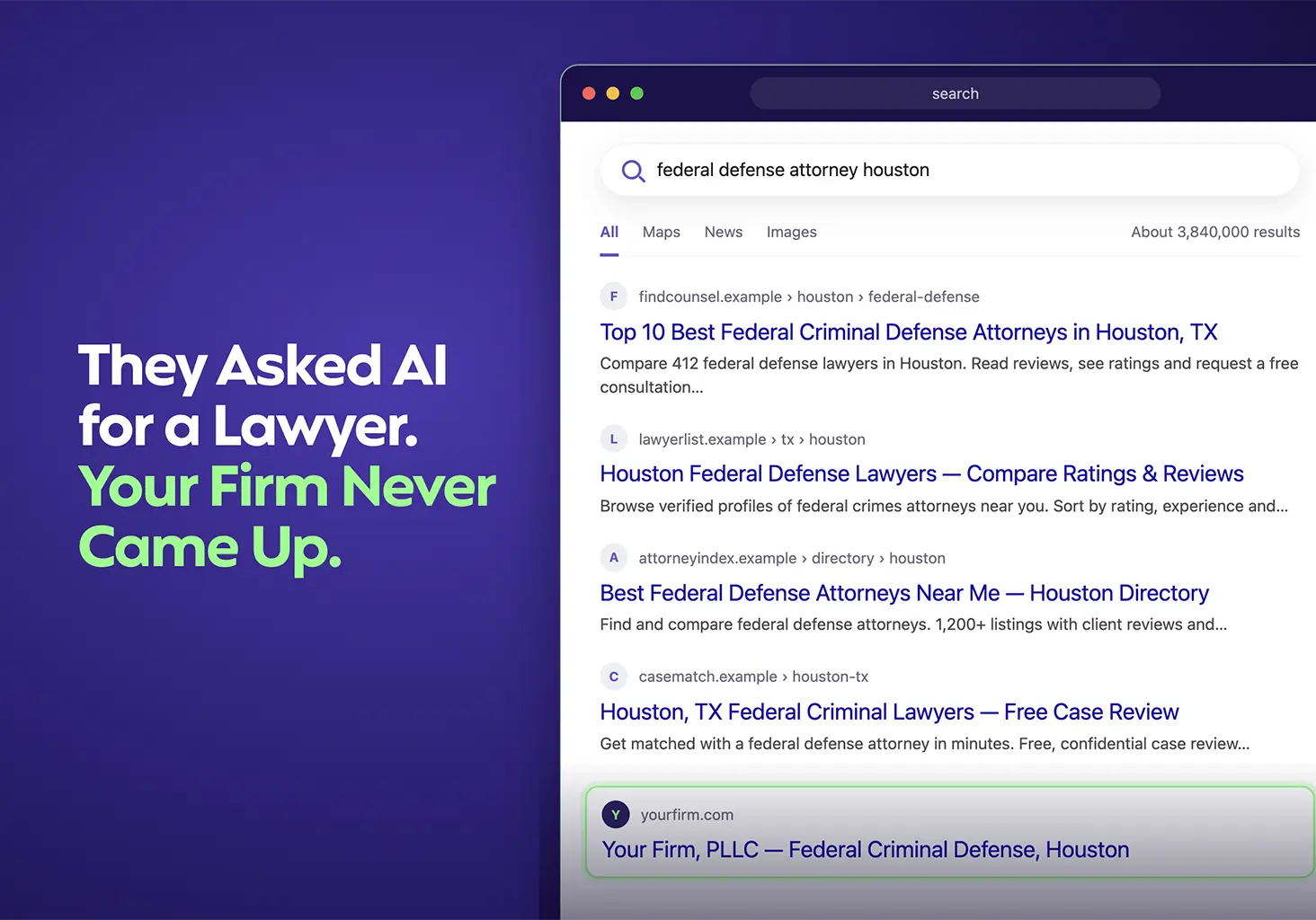
Try typing your practice area and your city into Google the same way a client would if they’re looking for legal help. Who or what comes up first? The first names are usually Avvo, Justia, and Super Lawyers, then two or three firms with deeper marketing budgets than yours, and your own practice somewhere down at the tail end or on the second page. What if you do the same search with ChatGPT or Claude? The best SEO for law firms covers both search engine and AI results pages.
You’re here because you know potential clients don’t make it to page two, and most of them are asking an AI tool before they ever open a search bar. The client who needs your exact services picks from whatever comes up first, and your firm never gets to enter the conversation. It doesn’t mean another attorney is better, but it does mean they’re easier to find.
Word of Mouth Used to Be the Whole Deal
Casework itself used to be marketing. You won an important case, a client told a friend, and a colleague passed along a matter outside their wheelhouse. Your reputation moved from one person to the next, and the website only had to look real enough for when someone heard of you and wanted to put a face to a name. It was a digital business card more than anything.
Those referrals probably still come in, and bring you some good cases. But they are no longer where most new clients start and stop when they need legal help. Someone with a sudden legal problem reaches for a search bar before a phone, often in a rough moment, and decides within seconds whether your firm looks like the one that can carry the weight.
The shift is bigger than law-focused. It is a sign of the times you can see across industries. We work with a lot of manufacturers, and a law firm’s website has more in common with a metal shop like SteelMart than most would guess. Both were built to confirm the business is real more than to bring in new customers, and that held up until clients started searching online, where an aging placeholder site leaves you invisible to the people now using these new sales channels.
The Real Competition Is Not Another Firm
The thing standing between you and a new client is rarely a better attorney. The roadblock is an ecosystem of directories where even big law firms fall down the totem pole of search results. Avvo, Justia, Super Lawyers, and FindLaw have spent years becoming domain-authority giants that Google trusts on reflex, so they hold the top of the page for nearly any legal search people are doing.
Even modern and fresh-looking websites will suffer in the new search dynamic. A freshly redesigned site with thin content and no search strategy loses to a directory just as badly as an outdated one. Though I have seen plenty of heavy-hitter law firms with 2009-looking sites, polish is rarely the issue. Plenty of these searches are local as well, the kind of attorney near me searching that a nearby firm should win, except a national directory grabs the click first.
So the client looking for you hits a directory instead, picks an attorney off it that lives 50 miles out of town, and never learns your firm was an option in the first place. You do not see the search, the lost consult, or the case. It simply never arrives, as many companies across just about every industry are also starting to feel right now.
Clients Are Asking AI Before They Ask You
AI is everywhere and anywhere, so you’re right to wonder whether AI is going to bury everything you do online. Where the search starts is changing, but not whether it happens. A lot of clients now open a chatbot before a search bar, ask about their situation, do some light competitor research, and reach your site already half-decided. For better or worse, the law firms an AI points them to are the ones that win the introduction.
That raises the stakes for your SEO strategy, which overlaps with AI search. You can still earn your way into ChatGPT and Claude citations, but it takes more than publishing helpful content and hoping the right people see it. AI likes to cite pages that already rank well, so content answering real client questions only lands once search engines can find and trust it. The work that earns a top ranking is the same work that earns the citation, and in trust-heavy areas like law the two run even closer together. The directories win here for the same reason, since the spots they hold are the ones an AI reads from.
As one question fans out into a dozen related searches, the work is answering the real questions directly, covering what a client types at each stage of a problem. The firms gaining ground build their content around those questions with FAQ pages and well-placed inserts. In a saturated market like Houston, where thousands of firms chase the same clients, listing and then answering those questions directly can give you a leg up on the competition.
The Best Law Firm SEO Companies Know YMYL
Most lawyers are aware of SEO and have a folder of monthly reports with no new clients to show for their efforts. Many end up buying a generic SEO playbook when they need best SEO for law firms specifically. Google scrutinizes legal sites harder than most, a standard it calls YMYL, short for your money or your life. Someone’s freedom or finances ride on the advice they find, and so the competition for those rankings is even tougher.
The best law firm SEO companies pull away from the pack in a few concrete ways:
- They chase search intent over raw volume, because the person typing “federal warrant search” needs you far more than the one typing “best attorney”
- They build the plan around what makes your practice distinct instead of a template that could front any firm (or business) in the country
- They report on consultations and qualified leads, not vanity charts that never explain where the clients went
- They use clean methods that protect a reputation you spent decades earning, not shortcuts that get a site penalized
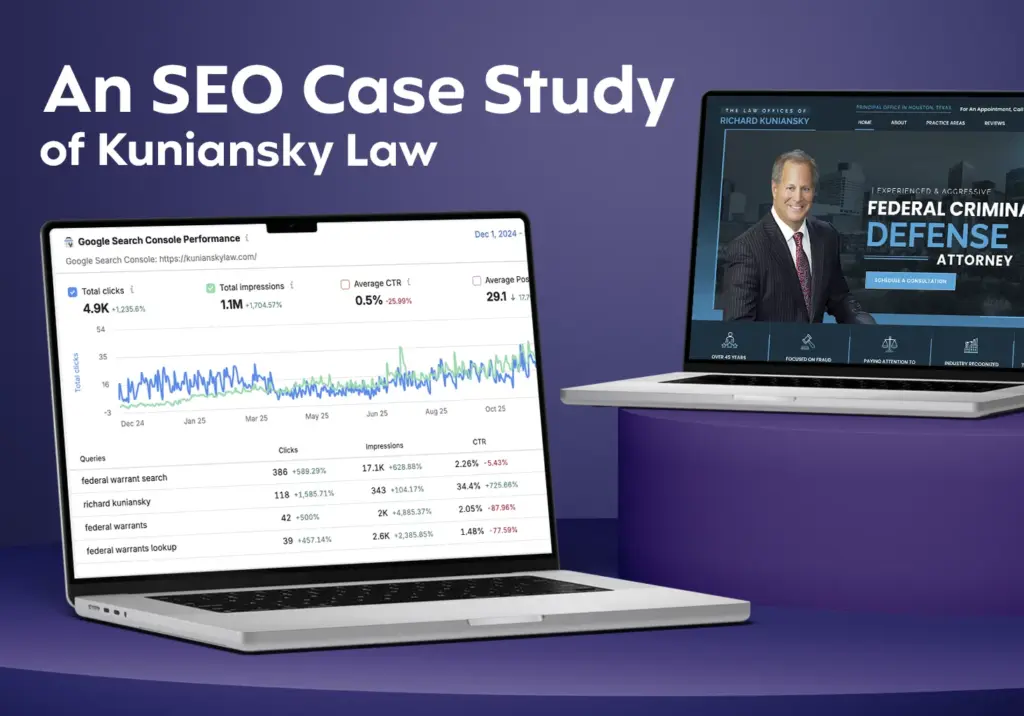
That intent-first approach is what reversed things for Kuniansky Law, a Houston federal criminal defense practice sitting beneath the directories after a previous team underdelivered. We built a strategy around how people search in a crisis and put Richard’s four decades in federal court at the center, and his organic clicks climbed more than 1,200% inside a year. The same standard carries across all of our SEO work, whatever the practice area or city.
Stop Letting Directories Take Your Cases
You do not need to turn into a full-time marketer to fix this. That’s what we’re here for. You need to know exactly who is outranking you for the cases you want and why, because once that picture is in front of you, most of it turns out to be fixable.
A free SEO audit gives you a starting place, the searches you are missing, and the firms taking them. The best SEO for law firms starts with that honest look, not a boiler-plate package and a promise.
FAQs About Law Firm SEO
Can my firm actually outrank Avvo and Justia?
For head terms like “personal injury lawyer,” rarely. And you don’t need to. Firms win by outranking directories on specific, local, intent-heavy searches: practice area + city, urgent questions (“what happens after a federal indictment”), and near-me searches. Those are the searches that produce consultations, and directories answer them generically. You can answer them exactly.
How long does SEO take for a law firm?
Most firms see early movement in 3 to 4 months and meaningful case flow in 6 to 12. Legal is a YMYL category, so Google trusts new content slowly. This is also why the gains hold once you’ve earned them. Anyone promising page one in 30 days is describing a shortcut that gets sites penalized.
How much does law firm SEO cost?
Typical retainers run anywhere from $1,500 to $10,000+ per month depending on market and practice area. The number that matters is cost per signed case: one federal defense matter or injury settlement usually pays for a year of the work. That’s the math a monthly report should actually show you.
Does SEO still matter now that clients ask AI first?
More than before. ChatGPT, Claude, and Google’s AI answers cite pages that already rank and already answer real questions directly. The same work that earns the ranking earns the citation. If you skip it, you’re absent from both places clients look.