When someone searches for a criminal defense attorney, they’re usually not casually browsing. They’re scared, stressed, and often need immediate help. That search behavior changes everything about how criminal defense lawyer SEO needs to work.
Richard Kuniansky, a Houston federal criminal defense attorney with 40+ years of experience, came to us after another SEO team left his practice with lackluster results. Potential clients for federal investigations or fraud were finding competitors instead.
Within a year, organic clicks increased 1,200%. High-intent queries like “federal warrant search” are now driving clicks from people facing very real federal legal issues.
This case study walks through how we boosted visibility for this federal defense practice in Houston’s hyper-competitive legal market.
Criminal Defense SEO Comes With Extra Rules
Criminal defense falls under what Google calls “Your Money or Your Life” (YMYL) content. YMYL means someone’s freedom, reputation, and future are on the line. That’s why Google applies stricter standards for trust, accuracy, and expertise than they do for most industries.
On top of stricter rules, SEO for criminal defense lawyers is highly competitive. The same keywords that cost $50+ per click in PPC ads are equally hard to rank for organically. Large legal directories and legacy firms with massive domain authority dominate results. And unlike local SEO strategies, where you want to focus primarily on local visibility, federal criminal defense requires serving Houston-area clients and also those dealing with federal charges.
Maybe those searching just received a target letter from the DOJ, or they’re trying to understand what an indictment means for their business. They don’t have patience for unclear information or over complicated websites that only create more questions.
Starting Point: Lost in Legal Directory Results
Kuniansky Law had a visibility problem that wasn’t obvious on the surface. Everything looked professional and polished. Our SEO audit revealed what was keeping the site from ranking:
- Directory Domination – Search results were packed with Justia, Avvo, and Super Lawyers profiles. These platforms have huge domain authority, making it an uphill battle for individual law practices to outrank them on generic terms most are aiming to target.
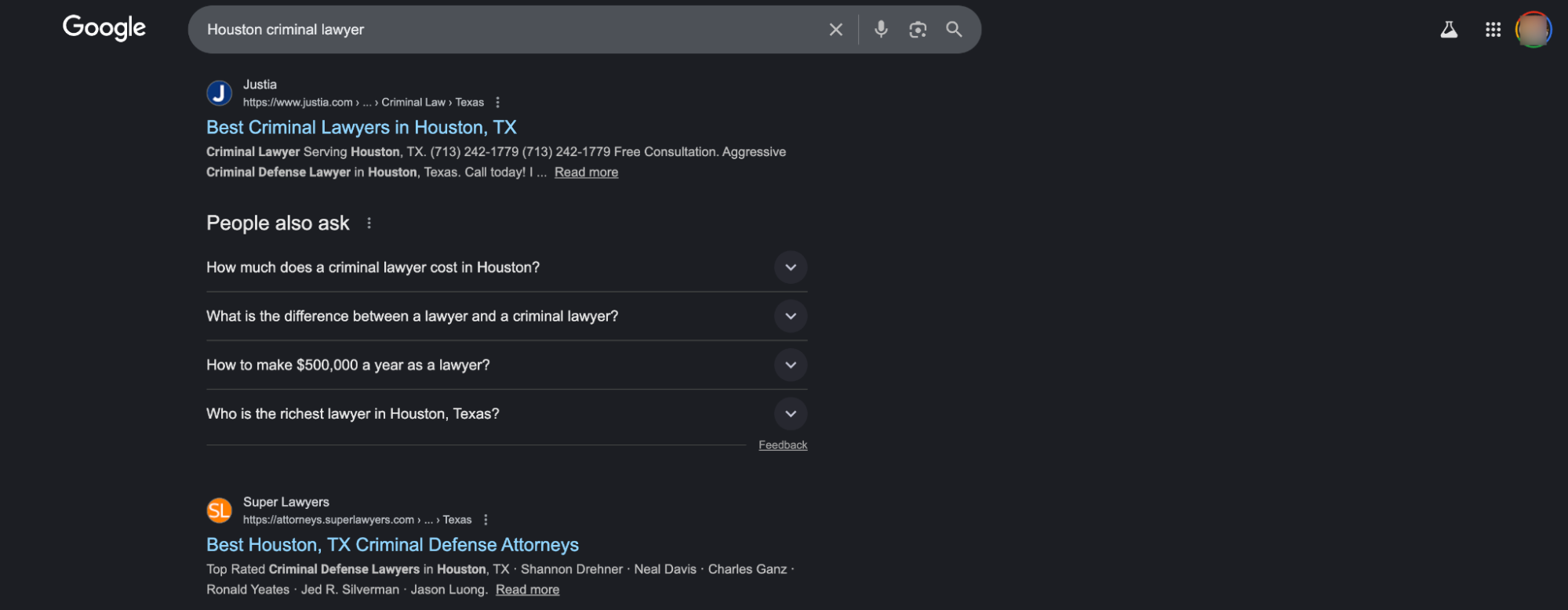
- Misaligned Content – Existing content focused on broad keywords rather than the specific, high-intent questions people actually ask when facing down federal charges. Someone searching “what happens during a federal investigation” has very different needs than someone searching “Houston criminal defense lawyer.”
- Shaky Technical Foundation – The site had a few indexing issues and structural problems that were blocking visibility despite the snazzy design.
Richard didn’t have the luxury of relying on referrals alone. He needed search to drive high-value traffic from his actual target audience. That’s where we come into the picture.
Entering Evidence: Kuniansky Law’s Criminal Defense Lawyer SEO Strategy
We built this SEO strategy around how people actually search when they need a federal criminal defense attorney like Richard, and what they are looking for:
Technical SEO Foundation and Site Architecture
To make the site easier for Google to crawl, we fixed several indexing problems, improved performance for mobile users, and cleaned up pathways between his practice pages and articles related to those pages. For YMYL sites like this, a poorly structured website destroys confidence when someone is looking for fast answers.
Search Intent Mapping Meets Content
A big part of this criminal defense SEO strategy was mapping keywords to actual search intent categories based on where someone is in their legal situation:
- Federal investigation queries – “what to do if FBI contacts you,” “how long do federal investigations take,” “federal warrant search,” “federal warrants lookup”
- Indictment concerns – “what does it mean to be indicted,” “federal indictment process”
- Specific federal crimes – “federal wire fraud penalties,” “federal conspiracy charges,” “healthcare fraud defense”
We created content to address these exact searches. One example is an article on white-collar crime enforcement patterns across Texas that explained Richard’s experience with how federal agencies prioritize cases in Houston’s energy sector versus Dallas’s financial district.
We also factored in AI search optimization. AI tools convert conversations into multiple targeted searches, so content needs to work in traditional search results and AI-generated summaries.
Local SEO For Federal Cases
Even though federal cases can involve clients from anywhere, some people still search with local intent. We optimized Richard’s Google Business Profile for federal criminal defense in Houston, created a posting schedule tied to what people were actually searching for, and fixed up his NAP (name, address, and phone number) listings across other lawyer directory listings.
Leveraging 40+ Years in Federal Criminal Law
Richard has practiced law for over forty years, and seven of them as a federal prosecutor. That’s the throughline now connecting his code-side SEO, content creation, and local visibility. We made sure this authoritative positioning feels natural across all the pages on the site.
As we walk through in our local SEO guide, quality beats quantity for where and how search engines and AI chatbots cite your website. And for criminal defense, credibility and overall site authority is going to lead to more qualified traffic than being listed everywhere and anywhere.
The Verdict: 1,200% Organic Click Growth
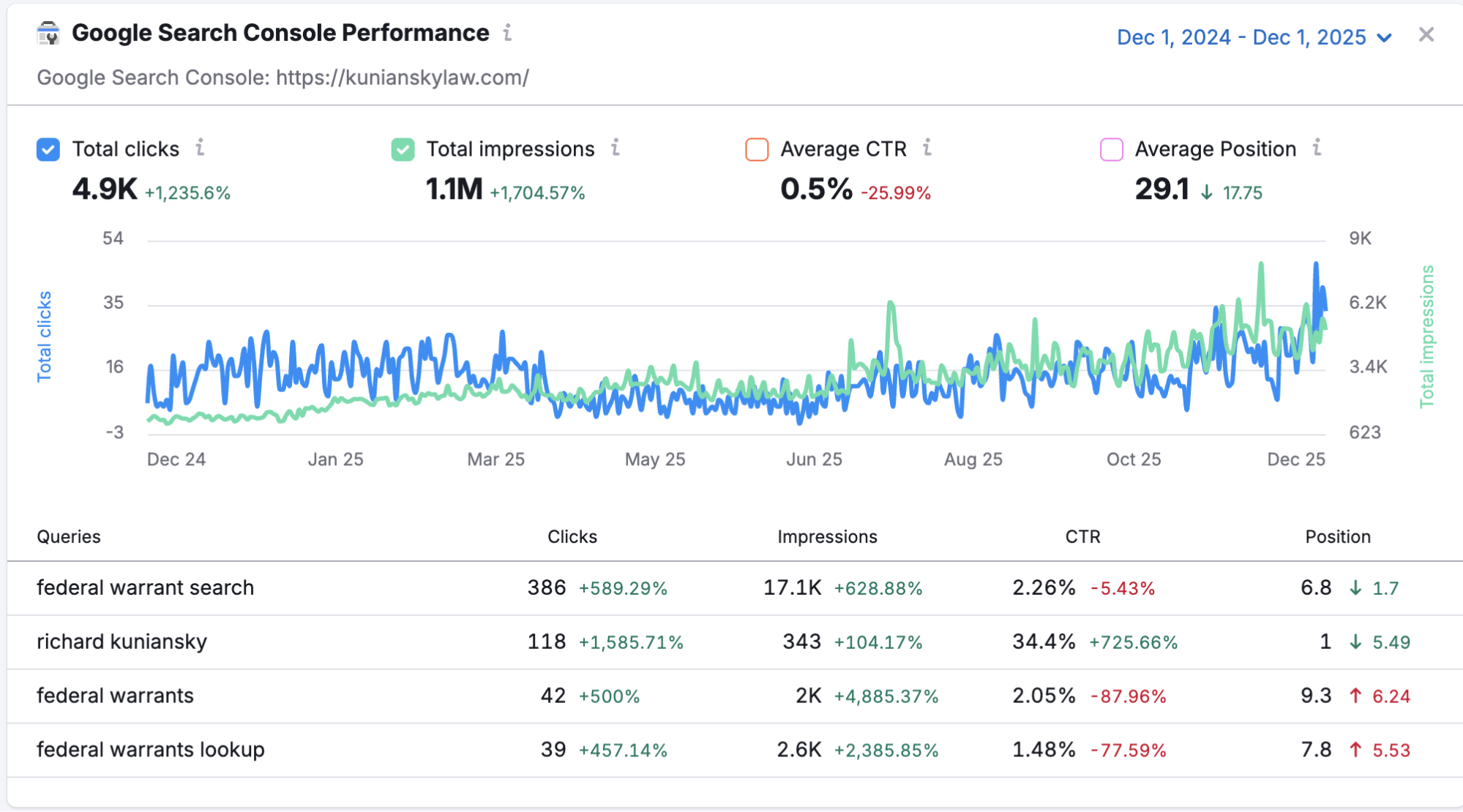
A year into the strategy, the search performance for Richard’s practice looked completely different. Traffic was up significantly, and it was coming from the high-intent federal queries we’d mapped out earlier, not broad-based “Houston lawyer” searches.
Year-Over-Year Growth:
- Organic clicks increased 1,236% – from minimal visibility to nearly 5,000 monthly clicks
- Impressions jumped 1,705% – reaching 1.1 million monthly impressions
- Average position improved by 18 positions – moving from page 4+ to page 2-3 range
RIchard’s firm started ranking for some of the high-intent queries we covered earlier:
- “Federal warrant search” – 386 clicks per month, position 6.8 (up 589%)
- “Federal warrants” – 42 clicks per month, position 9.3 (up 500%)
- “Federal warrants lookup” – 39 clicks per month, position 7.8 (up 457%)
These are individuals actively dealing with federal legal issues, finding Kuniansky Law at the exact moment they need this expertise. These are the right people at the right time.
Final Discovery: Counsel For Criminal Defense Lawyer SEO
If you’re a criminal defense attorney in Houston (like Richard), Atlanta (like most of our team), or any other saturated market, here’s what to keep in mind for your criminal defense law firm SEO:
Generic law firm SEO rarely works. The playbook for personal injury or estate planning won’t cut it for federal criminal defense. The trust curve is slower, content standards are higher, and Google’s scrutiny is stricter because of YMYL requirements.
Your unique positioning matters. Richard’s background as a former federal prosecutor became a competitive advantage once we made it central to the content strategy. What makes your practice different should drive your SEO approach, not templated “law firm marketing.”
Search intent beats keyword volume. We focused on specific, high-intent searches that indicated someone actually needed federal criminal defense representation right now. That’s how “federal warrant search” delivers more value than “best attorney” ever could.
For legal practices, visibility is the first battle. If qualified prospects can’t find you when they’re searching for exactly what you do, everything else (your credentials, case results, client service) doesn’t matter. Solving the visibility problem means you’re in the consideration set.
AI search is changing discovery. As we cover in our article on Houston law firm SEO, AI tools are increasingly how people research legal questions. Your content needs to work in both traditional search and AI-generated responses for how humans actually search.
Stop Losing Clients To Legal Directories
Criminal defense SEO takes time when you’re building trust signals and topical expertise in a heavily scrutinized niche. You might find YMYL rules add a few wrinkles to your efforts but when it’s done right, your search strategy builds sustainable visibility that’s hard to replicate.
If you’re competing in a saturated legal market and barely showing up when people search for your services, the first step is understanding where and why you’re losing out.
Whether for federal criminal defense, white-collar cases, or other legal work, start with our free SEO audit to pinpoint what’s holding your practice back.